Chasing P2E airdrop eligibility: the hours, the cutoff risk, and when to stop
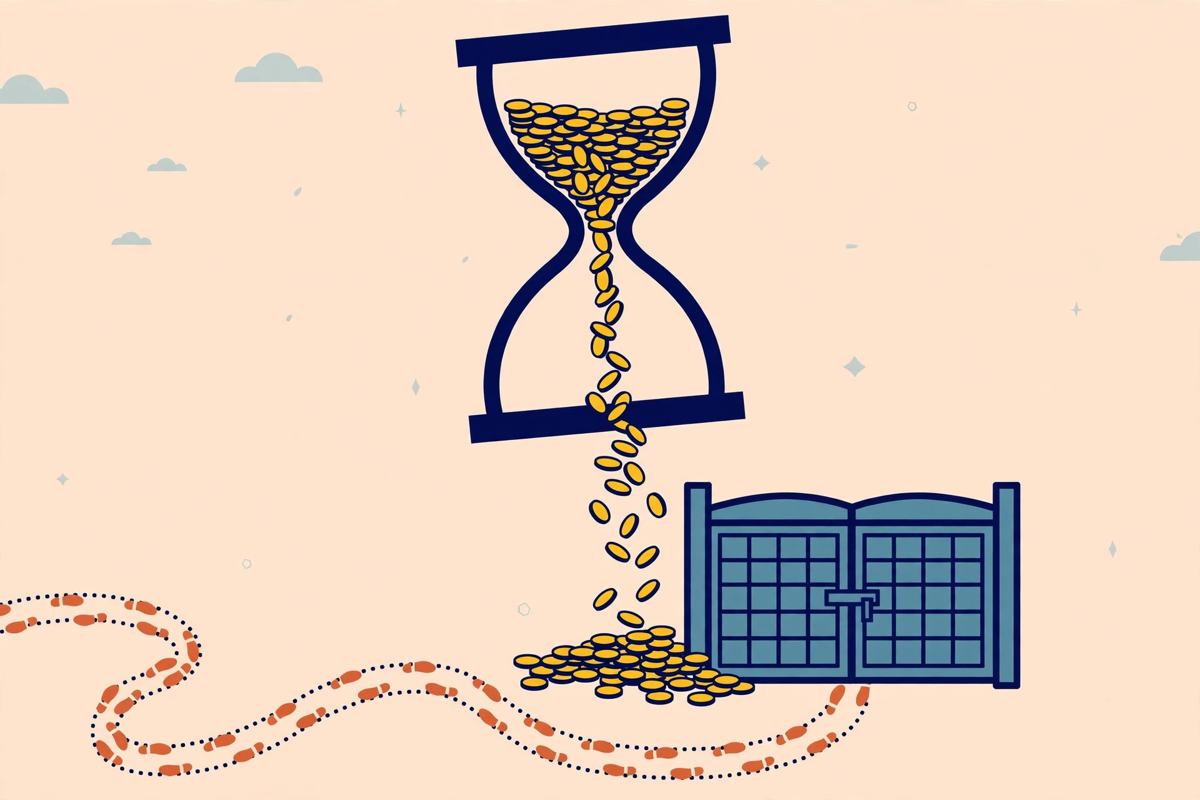
What exactly is being bought with all those hours? In most airdrop chases, the honest answer is a guess. The project has usually not published its eligibility rules, its snapshot date, or its allocation table in advance, so each transaction is a payment toward criteria that will only be revealed later, if a token launches at all. That does not make every chase irrational. It does mean the stop line has to be written before the chase starts, because the chase itself supplies a fresh reason to continue every week.
Disclaimer: This article is general information only and is not financial advice. Play-to-earn tokens are volatile, can lose all value, and past in-game rewards do not predict future rewards. Consider your own circumstances and, if needed, seek advice from a qualified professional.
Stop first: the kill criterion and the three zero outcomes
Write three numbers down before any farming routine begins. An hour budget for the whole chase, a fee budget in cash, and a review date. When any one of the three is reached, the chase pauses and is judged on what it has produced, which is usually nothing measurable. That is the kill criterion, and placing it first is deliberate. A criterion invented after forty hours have been spent will be invented to excuse the forty hours.
The reason for severity is that a chase can end at zero in three distinct ways, and effort protects against none of them. The first zero is a threshold zero. The wallet scores below the minimum and receives nothing, however many hours went in. The second zero is a filter zero. Anti Sybil rules reduce a score or disqualify a wallet that looked, to the project, like farming rather than use. The third zero is a deadline zero. Tokens were allocated, the claim window opened and closed on fixed dates, and an unclaimed allocation is gone. Each zero is documented in the case examined next, in a single distribution.
What eligibility actually was in a documented case
The Arbitrum Foundation published a full specification for its ARB distribution, which makes it a useful case precisely because the rules are now visible in complete form. The snapshot was taken at block 58642080 on Arbitrum One, dated February 6, 2023. Claiming started on March 23, 2023 and ended on September 24, 2023, and the specification states plainly that ARB is no longer claimable. Anyone who qualified and missed that window holds the deadline zero in its purest form.
Scoring ran on points. A wallet could earn at most one point per qualifying action performed before the snapshot, and scores were capped at 15. Qualifying actions included bridging funds into Arbitrum One and conducting transactions during two, six, and nine distinct months, a detail that rewards duration over intensity. Less than 3 points meant not eligible at all. In the published table, 3 points paid 1,250 tokens and 12 or more points paid 10,250 tokens. Timing changed the value further. Points scored after the Nitro launch were worth half as much, so a wallet that only became eligible after that point had a minimum entitlement of 625 tokens, half the table minimum.
The filter zero is documented with equal precision. If all of a wallet transactions occurred within a 48 hour period, one point was subtracted. If a wallet held less than 0.005 ether and had interacted with no more than one smart contract, one point was subtracted. Addresses identified as Sybil addresses during an earlier protocol bounty program were disqualified outright. Read those three rules as a description of what hurried farming looks like from the other side. Activity compressed into a short burst, a thin wallet balance, and a narrow set of contracts are exactly the patterns a late, anxious chase produces, and exactly the patterns the rules penalised.
The hour and fee ledger: a worked cost calculation
Every transaction in a chase pays a network fee whether or not it ever counts toward eligibility. Ethereum documentation states the general mechanic clearly. The gas fee equals the amount of gas used multiplied by the cost per unit of gas, fees are paid in ether and quoted in gwei, and the fee is paid regardless of whether a transaction succeeds or fails. A chase therefore has a guaranteed cost side and an entirely speculative revenue side. The ledger has to reflect that asymmetry.
Hypothetical worked example, labelled as such, with round numbers chosen for clear arithmetic and no claim about any current fee or any future token. Suppose a chase involves 3 sessions a week for 10 weeks, at 40 minutes a session. That is 20 hours. Suppose each session involves transactions costing, in total, the equivalent of 2 dollars in network fees. Fees total 60 dollars. The full cost of the chase is 20 hours plus 60 dollars, spent before any eligibility is known. Now place three outcomes beside it. In the threshold, filter, and deadline cases the return is zero, so the effective hourly result is a loss of time plus 60 dollars. In a qualifying case the return depends on a token price at a future claim date, which no ledger can honestly enter in advance. The correct entry for expected revenue, at the start, is unknown, not a hopeful number borrowed from a previous distribution.
That framing produces a simple decision rule. A chase is priced like an experiment, not like work. Experiments get small, fixed budgets and produce information. Work gets judged on output. Calling a chase work while entering its revenue as unknown is the accounting error that keeps losing chases running for months.
A bounded chase: the procedure
- Write the kill criterion first. Record an hour budget, a cash fee budget, and a review date in a place outside the wallet and outside the game, before the first transaction.
- Separate use from farming. List which actions would be taken anyway because the game or application is genuinely used, and which are being done only for a hoped for distribution. Only the second list counts against the chase budgets.
- Spread activity like a user, not a burst. Documented anti Sybil rules penalise activity compressed into a short window and thin, narrow wallet histories. Regular, modest activity over distinct months matches the pattern documented scoring rewarded.
- Log hours and fees weekly. Record sessions, minutes, transaction counts, and fees paid in the native coin and in a common currency. A chase without a log cannot be judged at its review date.
- Calendar every announced date. When a snapshot, claim opening, or claim deadline is published, enter it immediately with a reminder well before the deadline. The deadline zero is the only zero that is fully preventable.
- Judge at the review date, then stop or renew once. Compare hours and fees spent against the budgets. Renewal requires a new written criterion and a reason based on published information, not on the amount already spent.
What success looks like: a chase that ends, one way or the other, inside its budgets, with a complete log of hours and fees, every published date met, and a final entry that states what was received, including the answer nothing. A chase that cannot produce that record was never bounded.
When a chase is still defensible
Three conditions can make a limited chase reasonable, and they are conditions, not vibes. First, the underlying game or application is used and enjoyed without any distribution, so the hour cost is partly entertainment rather than pure speculation. Second, the activity is modest and regular, of the kind that documented scoring systems have rewarded, rather than a compressed burst built to imitate a history. Third, the budgets are small enough that the threshold zero, the filter zero, and the deadline zero are all affordable outcomes, priced in advance as real possibilities.
Notice what is absent from that list. The size of a previous distribution is absent, because a published allocation table from a finished snapshot describes a closed event, not an open one. Social media confidence is absent, because it carries no snapshot date and no points table. Sunk cost is absent most of all. Hours already spent are gone in every outcome. The only question a review date ever has to answer is whether the next hour, judged on published information alone, is worth buying. Often it is not, and stopping at the written line is the result the procedure was built to produce.
Disclaimer: This article is general information only and is not financial advice. Play-to-earn tokens are volatile, can lose all value, and past in-game rewards do not predict future rewards. Consider your own circumstances and, if needed, seek advice from a qualified professional.
— Sterling Cole, Money Writer — Earning Desk