The hardware and electricity costs of play-to-earn gaming: the cost per hour most earning guides skip
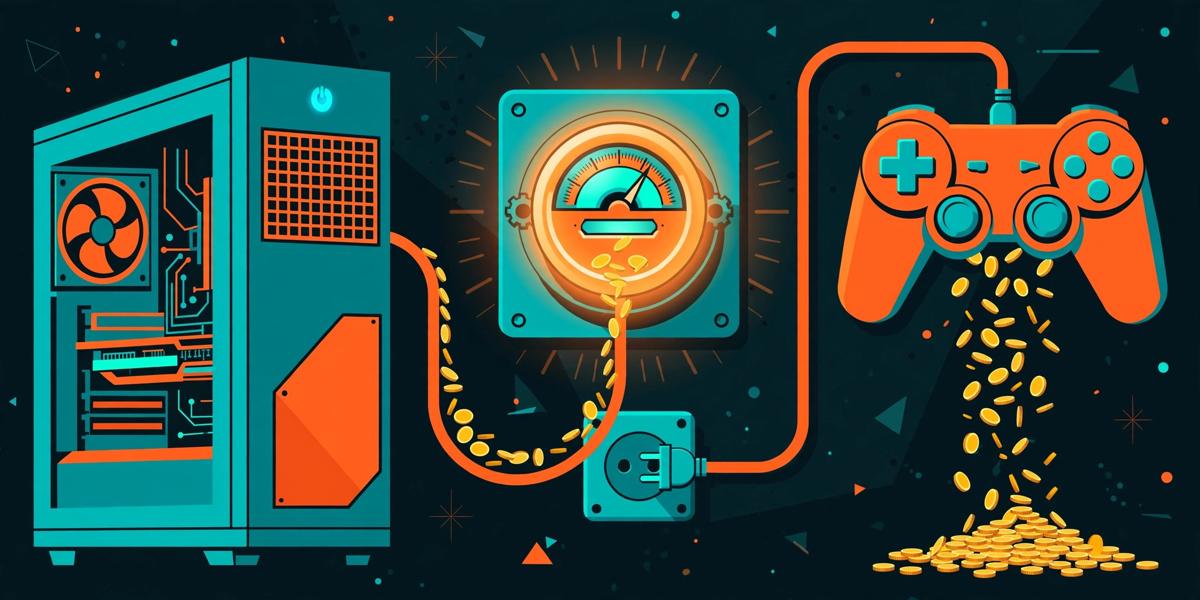
Your gaming setup charges you by the hour, whether a game pays you or not. Electricity is the small part of that charge. Hardware wearing out on a schedule is the large part, and it is the part almost no play-to-earn guide counts, because a guide that subtracts it has to publish a much smaller number. This article prices both, per hour, at regulated Ontario electricity rates, and states the kill criterion up front: the earnings per hour below which a setup costs more to run than the game returns.
Disclaimer: This article is general information only and is not financial advice. Play-to-earn tokens are volatile, can lose all value, and past in-game rewards do not predict future rewards. Consider your own circumstances and, if needed, seek advice from a qualified professional.
The kill criterion first: when the meter eats the reward
Write this line before starting any game on any new setup. Net earnings per hour equals the value of rewards earned per hour, valued when you could actually sell them, minus the running cost per hour from the tables below. If the net figure is zero or negative for 30 days of honest ledger entries, the setup is a hobby with a power bill, and the earning experiment stops or moves to cheaper hardware. A hobby is a fine thing to have. It is a bad thing to mistake for income.
The criterion has a second edge for anyone considering a purchase. Hardware bought for a game must be recovered from that game's net rewards before the hardware's useful life ends or the game changes its economy, whichever comes first. If the break-even month lands beyond the point where you can honestly project the game's rewards, the purchase fails on arithmetic alone, before token price risk is even discussed.
The two running costs most guides skip
Electricity. The formula is simple and worth memorising: average watts drawn at the wall, divided by 1,000, multiplied by your price per kilowatt-hour, multiplied by hours played. That gives the electricity cost of any session on any device. The figure that matters is the whole setup's draw at the wall. A graphics card's board power rating and a processor's TDP are design figures, not measurements; they leave out the rest of the machine, the monitor, and power supply losses.
Hardware amortisation. A machine bought for a price and used for a number of months costs that price divided by those months, every month, whether it earns or not. A $500 machine spread over 36 months is $13.89 per month of quiet, continuous cost. Ownership math used by cost comparison sites runs the same way: purchase price, minus eventual resale value, plus electricity, plus maintenance and upgrades. Resale value is real and belongs in the calculation, but only at a figure you could actually get, not the figure that makes the spreadsheet behave.
One distinction decides whether amortisation belongs in your personal math at all. Hardware you already own, and would keep anyway, charges you only its electricity and its wear when you play; the purchase is sunk. Hardware you are thinking of buying charges you everything. Most bad P2E purchases happen when sunk-cost math, which is correct for an owned machine, gets quietly applied to a new one.
Cost per hour by device: a worked comparison
The electricity rates are sourced: the Ontario Energy Board's Regulated Price Plan prices effective November 1, 2025 set Time-of-Use power at 9.8 cents per kWh off-peak, 15.7 cents mid-peak, and 20.3 cents on-peak, with a Tiered plan at 12.0 cents for the first 1,000 kWh a month. The device draws below are labelled scenario assumptions chosen to make the arithmetic transparent, not measurements of specific products; measure your own setup with the procedure further down and replace them. The table uses the mid-peak rate, 15.7 cents, because evening play before 7 p.m. and daytime weekend play both land near it for many households.
| Scenario device | Assumed wall draw | Electricity per hour at 15.7 cents per kWh | Electricity per 100 hours |
|---|---|---|---|
| Gaming PC, mid-range, with monitor | 300 watts | 4.7 cents | $4.71 |
| Console with television | 150 watts | 2.4 cents | $2.36 |
| Laptop, integrated graphics | 60 watts | 0.9 cents | $0.94 |
| Phone, plugged in while playing | 10 watts | 0.2 cents | $0.16 |
Electricity, honestly priced, is small. Even the gaming PC at the on-peak rate of 20.3 cents per kWh costs about 6.1 cents an hour. A player who grinds 100 hours a month on that PC spends roughly $4.71 to $6.09 on power, meaningful against small rewards, decisive against almost none. Anyone who tells you electricity is why a P2E setup loses money has usually not done the second calculation.
The second calculation is hardware. Take the scenario PC at a $1,200 purchase price, a $300 resale value after 36 months, and 60 hours of play a month. Net hardware cost is $900 over 36 months, which is $25 a month, or about 42 cents per hour of play. Add mid-peak electricity and the running cost lands near 46 cents per hour. The same 60 hours on an already owned console costs about 2.4 cents per hour in electricity, with wear as the only honest extra. The gap between those two numbers, not the power bill, is where P2E setups live or die.
The break-even the hardware buyer actually faces
Break-even hours equal the net hardware cost divided by the net reward per hour after electricity. Run it with labelled scenario rewards. If a game returns rewards you could sell for 50 cents per hour of play, and the PC scenario above costs 46 cents per hour to run, the net is 4 cents per hour, and recovering $900 of net hardware cost takes 22,500 hours. That is not a plan; it is a refusal wearing a spreadsheet. At a $2 per hour reward scenario, the net is about $1.54 per hour and break-even lands near 585 hours, roughly 10 months at 60 hours a month, which is at least a claim a player can test against a game's track record.
Notice what the formula refuses to do. It does not ask whether the token might rise. A reward counted at a hoped-for future price is not earnings; it is a speculation stacked on top of a cost that is charged in real money every month. Value rewards at what they could be sold for when earned, the same discipline the earnings ledger guides on this site apply to every other line, and let any later rise be a windfall rather than the business model.
Measure your own draw in four steps
- Get a wall measurement. Plug the full setup, PC or console, monitor, and powered speakers, through a plug-in power meter, or read the draw from a smart plug that reports watts. Component ratings will not do; the wall figure is the one the formula needs.
- Measure a representative session. Record the average draw across at least an hour of the game you actually play, in the mode you actually play it. Menus and loading screens draw less than active play, and a flattering measurement produces a flattering lie.
- Take the rate from your own bill. Use the per kWh price on your utility bill, including which time-of-use period your play hours fall in. Ontario players can check their period against the OEB prices quoted above; players elsewhere should use their own bill, not this article's rates.
- Do the division, then write it in the ledger. Watts divided by 1,000, times rate, times hours gives session electricity cost. Add the hardware line if the machine was bought for this: price minus realistic resale, divided by months, divided by monthly hours. Record both as costs against the game's rewards.
What success looks like: one measured watt figure, one rate from a real bill, and a running cost per hour written next to the game's rewards in the same ledger, close enough that the kill criterion at the top of this article can be applied without guessing.
Who should not buy hardware for a game
Anyone whose break-even month lands after the game's current season, anyone whose reward figure depends on the token rising, and anyone financing the purchase. A credit card charges interest on a schedule that does not care about patch notes. The honest alternatives are unglamorous and effective: play on hardware already owned, prefer games that run on a phone or an integrated graphics laptop where the running cost rounds to zero, and treat any game that genuinely needs a new machine as a purchase of entertainment first, with earnings as a possible rebate. When the rebate covers the meter, keep playing. When it does not, the kill criterion has already told you what to do.
Disclaimer: This article is general information only and is not financial advice. Play-to-earn tokens are volatile, can lose all value, and past in-game rewards do not predict future rewards. Consider your own circumstances and, if needed, seek advice from a qualified professional.
— Sterling Cole, Money Writer — Earning Desk