Withdrawal minimums and network fees: when a P2E balance costs more to move than it is worth
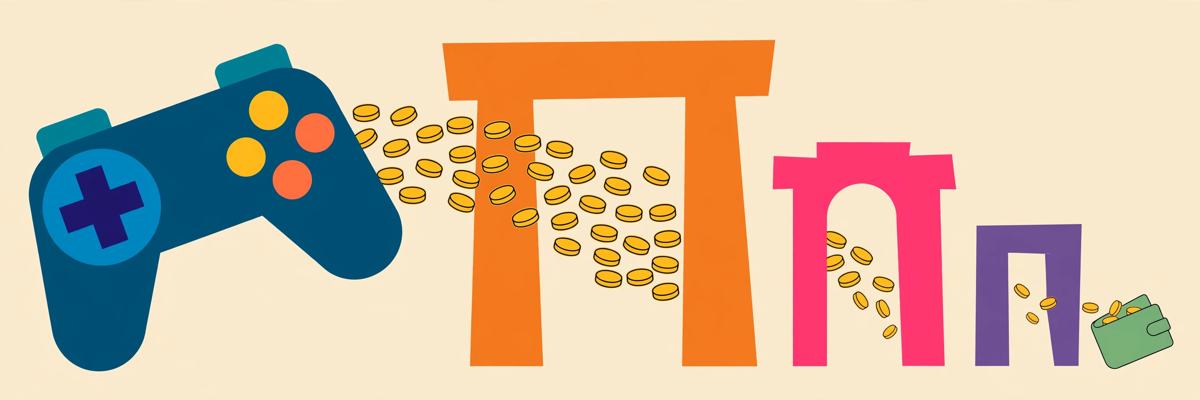
12 dollars. That is the balance in the worked example below, and by the time it has crossed three hops it is worth less than the cost of crossing them. Small play-to-earn balances fail in a specific way. The reward itself can be real, the wallet address can be correct, and the move can still be a loss, because every hop charges a flat fee and every hop can impose its own minimum. This guide counts the hops first, prices each one, and only then decides whether to move, wait, or leave the balance where it sits.
Disclaimer: This article is general information only and is not financial advice. Play-to-earn tokens are volatile, can lose all value, and past in-game rewards do not predict future rewards. Consider your own circumstances and, if needed, seek advice from a qualified professional.
Start with the balance that actually arrives
A game screen shows a gross balance. No player spends a gross balance. What matters is the net amount that arrives at the final destination after each transfer fee, each swap fee, and each exchange withdrawal fee has been taken. Most crypto costs are flat or close to flat per transaction, not proportional to the amount moved, so a fee that is trivial on a large transfer can consume most of a reward sized transfer. A balance so small that moving it costs about as much as, or more than, it is worth is informally called dust. Dust is not lost. It is simply uneconomic to move until the balance grows or fees fall.
That distinction changes the order of operations. Checking the final minimum first is backwards. If a balance is below a withdrawal minimum it cannot be withdrawn yet, and a deposit that lands below a later swap minimum may not execute as planned. The amount to compare against each later minimum is the amount that will actually arrive after the previous hop has taken its fee, not the larger number displayed inside the game.
Count every hop before you move anything
Write the route down as a list, one line per hop. A common route has three hops. The game or app pays out to a wallet. The wallet swaps the game token for a widely traded token, or sends it to an exchange. The exchange then withdraws to a bank or to another wallet. Some routes have a fourth hop, a bridge between networks, and each added hop adds one more flat fee, one more minimum to clear, and one more address and network label to check.
Counting hops also exposes a quieter problem. Each hop can be denominated in a different unit. The game pays in its own token. The network charges in its native coin. The exchange quotes its minimum in the asset being withdrawn. A route that looks cheap when every number is read as dollars can be expensive once each charge is converted honestly. The runbook below forces that conversion before any funds move, while a mistake is still free to fix.
Price each hop in the coin it charges
On Ethereum, the official documentation defines the gas fee as the amount of gas used multiplied by the cost per unit of gas. Fees are paid in ether and quoted in gwei, with each gwei equal to 0.000000001 ether. The total splits into a base fee set by the protocol and a priority fee set by the sender as a tip. A standard ether transfer uses 21,000 units of gas, and more complex actions, such as token transfers and swaps, use more. Two further facts from the same documentation matter for small balances. The fee is paid regardless of whether a transaction succeeds or fails, so a failed attempt is a real cost, not a free retry. And the base fee can rise or fall by up to 12.5 percent per block depending on how full blocks are, so the price of the same hop is not fixed across a busy evening.
Solana shows the opposite end of the range, and the contrast is instructive. Every Solana transaction requires a fee paid in SOL. The official fee documentation puts the base fee at 5,000 lamports per signature, split evenly between burning and the validator, with an optional prioritization fee on top that raises the chance of being scheduled ahead of competing transactions. A flat fee that small rarely decides a withdrawal on its own. The lesson is not that one network is better. The lesson is that the fee line must be priced network by network and hop by hop, because a route that mixes networks inherits the most expensive hop in full.
Exchange minimums add a second, separate gate. Coinbase states in its help documentation that each asset has a minimum withdrawal amount of its own, giving bitcoin as the worked example at 0.0001. For transfers off the platform, the fee charged is based on an estimate of prevailing network fees, and all fees are disclosed at the time of the transaction. Read that as a procedure point. The minimum belongs to the asset, not to the account, so a balance that clears a minimum in one token says nothing about a different token on the same account.
The break even balance: a worked calculation
Hypothetical worked example, labelled as such, with round numbers chosen for clear arithmetic. It is not a quote of any current fee and it is not a prediction. Suppose a game balance is worth 12 dollars. Hop one, the payout to a wallet, charges the equivalent of 1 dollar. Hop two, a swap, charges 3 dollars in network fees at a busy moment. Hop three, an exchange withdrawal, charges 2 dollars. Total cost to move is 6 dollars, and 6 dollars arrives. Half the reward was spent moving it.
Now run the same route at a balance of 60 dollars with identical flat fees. Total cost is still 6 dollars and 54 dollars arrives. The route did not improve. The balance grew, and the flat fees shrank as a share. That is the whole calculation, and it gives a usable rule. Define the fee share as total route cost divided by gross balance. In the first case the share is 50 percent. In the second it is 10 percent. A player who sets a personal ceiling in advance, for example refusing to spend more than 15 percent of a balance on moving it, can solve for the break even balance directly. Break even balance equals total route cost divided by the chosen ceiling. At 6 dollars of route cost and a 15 percent ceiling, the balance needs to reach 40 dollars before the move clears the rule.
Add one stress test before trusting the result. Price the busiest hop at double its quiet estimate, because the Ethereum base fee moves with demand and a failed transaction still consumes its fee. If the stressed fee share still clears the ceiling, the move is robust. If only the quiet estimate clears it, waiting for a quieter period is part of the plan, not an afterthought.
A five step withdrawal runbook
- List the hops. Write every transfer, swap, bridge, and withdrawal between the game balance and the final destination, in order, with the network named on each line.
- Record each minimum. Note the withdrawal minimum for the exact asset at each hop, and check each one against the net amount arriving from the previous hop, not the starting balance.
- Price each fee in its own coin. Note which native coin pays each network fee, confirm the wallet holds some of that coin, and convert each fee to a common currency for the total.
- Do the division. Total route cost divided by gross balance gives the fee share. Compare it with a ceiling chosen before starting, and repeat the calculation with the busiest hop doubled as a stress test.
- Move once, or wait on purpose. If the stressed share clears the ceiling, consolidate and move in as few transactions as possible, saving each transaction identifier. If it does not, leave the balance to accumulate and set a specific balance target that would clear the rule.
What success looks like: a short written route with a minimum and a fee on every line, a fee share calculated twice, once at quoted fees and once stressed, and a decision that follows from those two numbers. If the record cannot be written, the route is not understood well enough to send money along it.
When waiting beats withdrawing
Waiting is a decision with its own risks, and it should be made openly. A balance left inside a game stays exposed to that game changing its payout rules, raising its minimum, or closing. A balance left unconverted stays exposed to the token price. Those risks argue for moving promptly when the math clears. The fee share argues against moving when it does not. The framework that reconciles both is a pair of triggers set in advance. A balance trigger, the amount at which the fee share clears the chosen ceiling, and a time trigger, a latest date by which the balance is moved even at a worse share if the game shows signs of trouble. Whichever trigger fires first governs.
One last check belongs on every route. Confirm that the destination network label matches the sending network exactly, and that the receiving wallet holds the native coin needed for the next fee. More small balances are stranded by a missing fee coin or a mismatched network than by the headline fee itself. The cheapest withdrawal is the one that only has to be done once.
Disclaimer: This article is general information only and is not financial advice. Play-to-earn tokens are volatile, can lose all value, and past in-game rewards do not predict future rewards. Consider your own circumstances and, if needed, seek advice from a qualified professional.
— Sterling Cole, Money Writer — Earning Desk